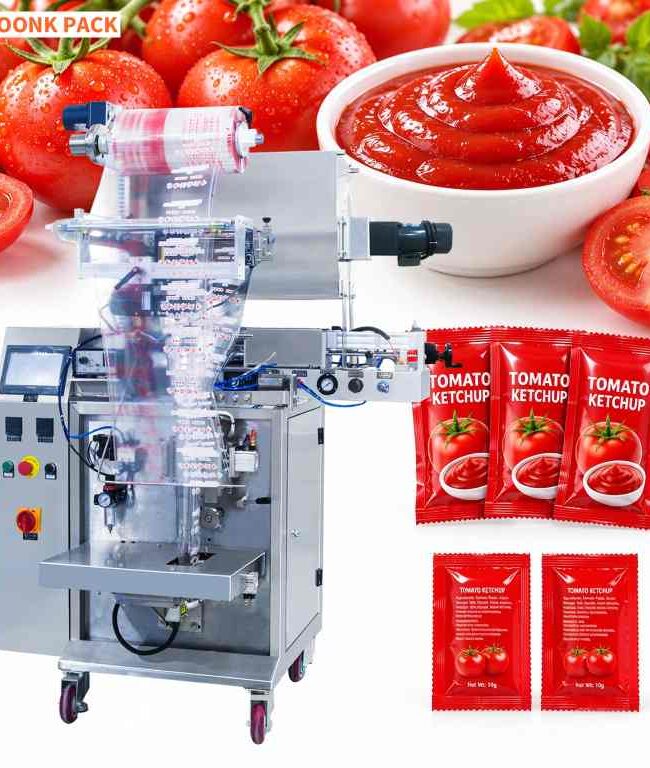
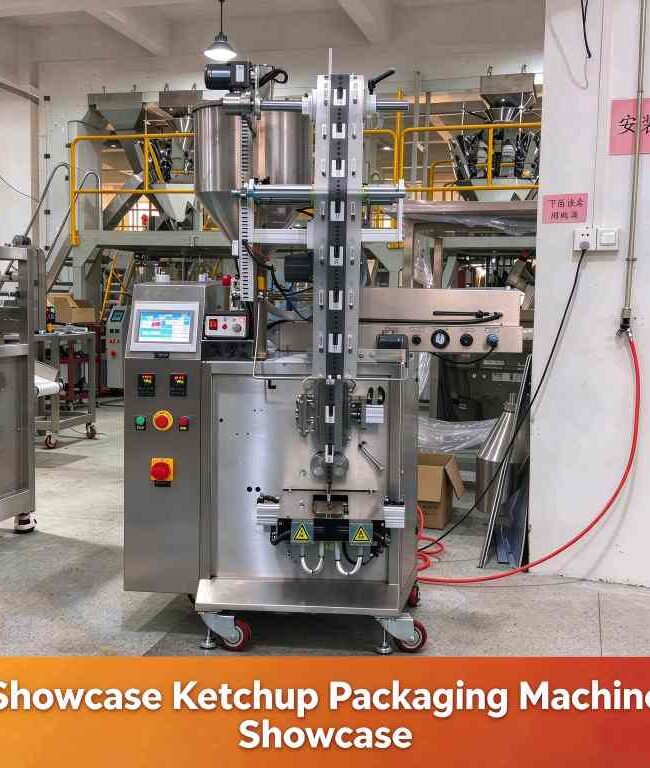
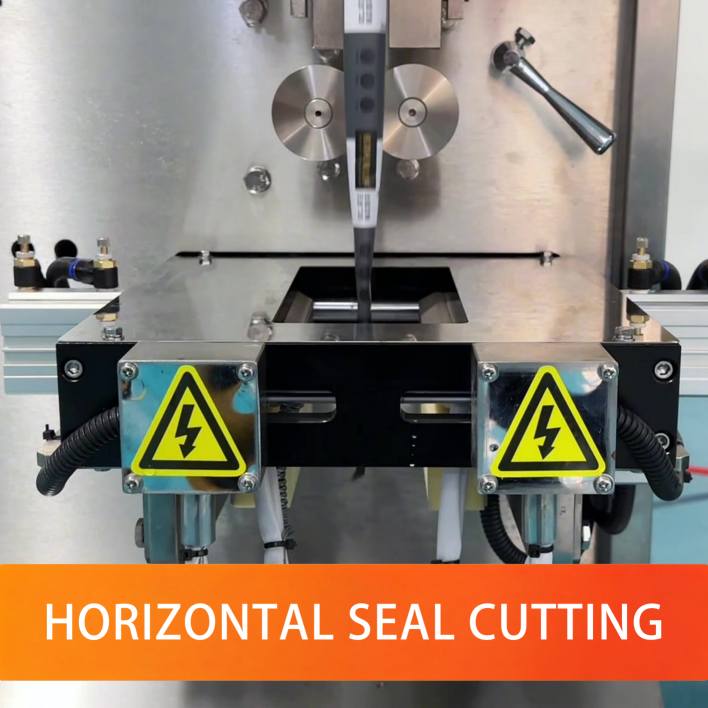
Automatic Tomato Ketchup Sachet Packaging Machine: Pneumatic Dosing Solution for 3-Side Seal Pouches
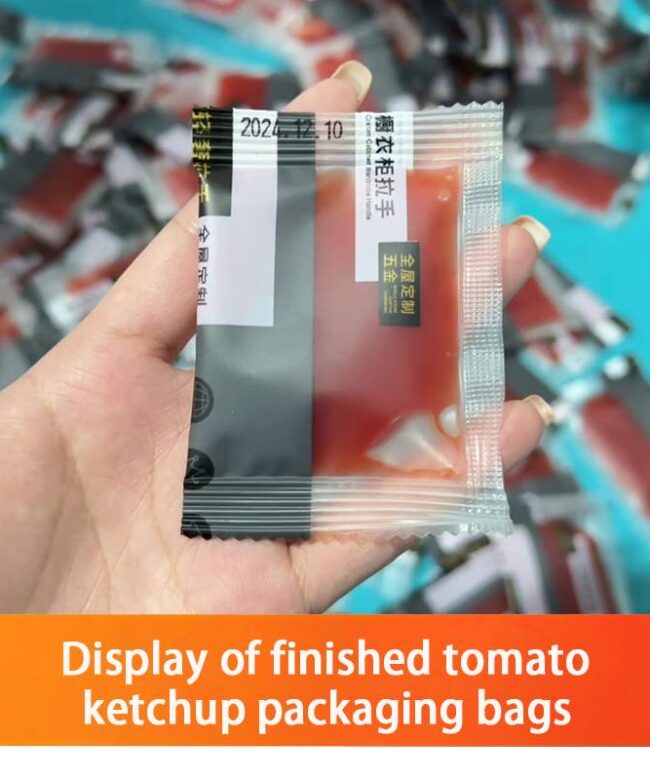
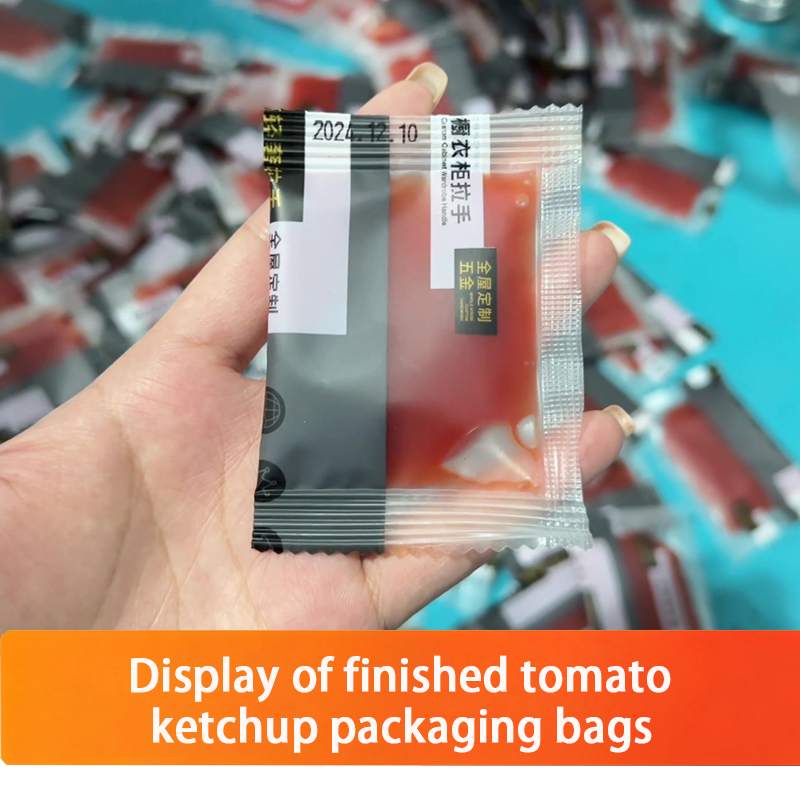
Driven by the explosive expansion of quick-service restaurant (QSR) chains, food delivery platforms, airline catering, and institutional meal services worldwide, demand for single-serve condiment packaging has reached an all-time high. Portioned packaging—specifically 5g to 30g 3-side seal sachets—offers undeniable consumer convenience, hygiene assurance, and precise portion control.
However, for food processing enterprises and sauce contract packers (co-packers), packaging high-viscosity paste products like tomato ketchup presents severe technical hurdles. Standard liquid fillers or gravity-fed vertical form-fill-seal (VFFS) equipment frequently fail when handling non-Newtonian, thixotropic pastes. The result is product tailing, seal-area contamination, net-weight fluctuations, and high seal-leakage rates that eat into profit margins and damage brand reputation.
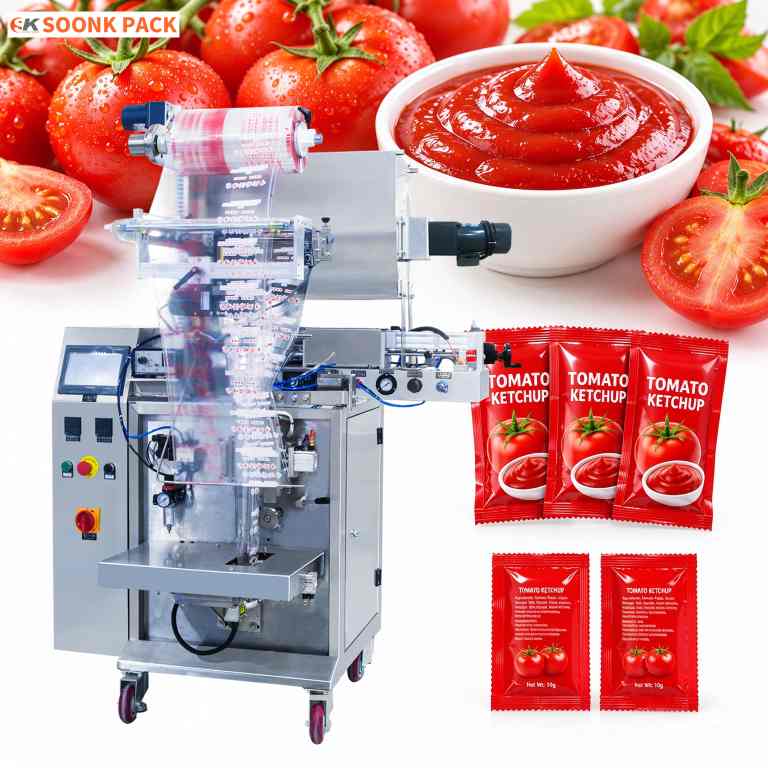
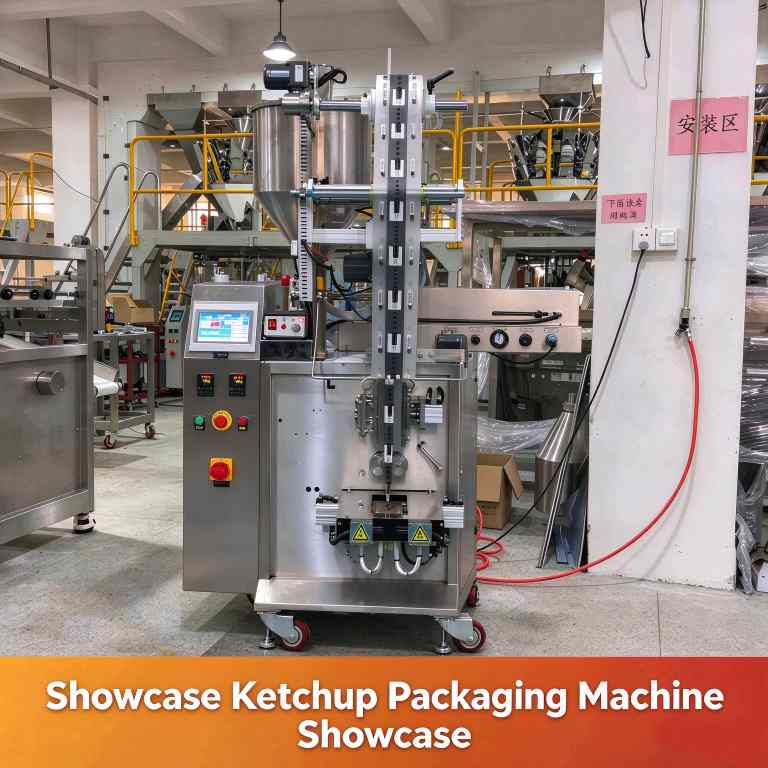
The 3-Side Seal Automatic Tomato Ketchup Sachet Packaging Machine is engineered specifically to eliminate these operational bottlenecks. By combining a heavy-duty pneumatic volumetric piston dosing mechanism with a positive-acting anti-drip cut-off system, this industrial-grade machine automates the entire packaging cycle—from film unwind, bag forming, volumetric dosing, and thermal sealing to date printing and pouch discharge.
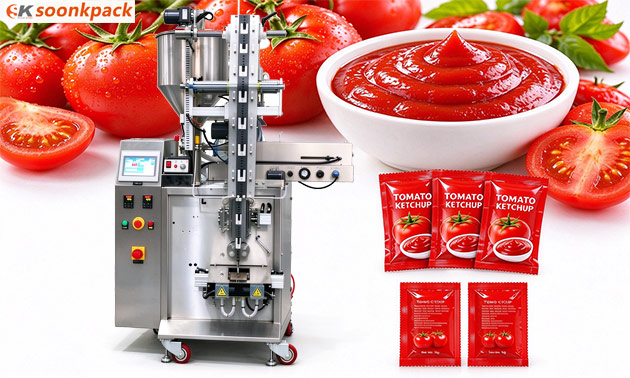
Technical Specifications & Machine Performance
| Feature / Parameter | Technical Specification |
|---|---|
| Packaging Style | 3-Side Seal Sachet / Pouch (Optional 4-side seal upon request) |
| Dosing Mechanism | Heavy-Duty Pneumatic Volumetric Piston Pump |
| Filling Range | 5 ml−50 ml/10 ml−100 ml (Customizable cylinder strokes) |
| Dosing Tolerance | ≤±1% (Volumetric accuracy) |
| Production Speed | 40−90 sachets/min (Varies by viscosity, film type, and pouch volume) |
| Pouch Dimensions | Length: 50−200 mm | Width: $30 – 150\text{ mm |
| Max Film Roll Width | Max 320 mm |
| Compatible Film Materials | PET/PE, PET/AL/PE, NY/PE, BOPP/PE, and other heat-sealable laminates |
| Structural Material | Heavy-duty SUS304 Frame; Food-Contact Parts in SUS304 / SUS316 Stainless Steel |
| Control System | PLC Interface with Ergonomic Touchscreen HMI |
| Pneumatic System | Pressure: 0.6MPa |
| Power Supply | 220V/380V,50Hz/60Hz, Power Consumption: 2.0 kW |
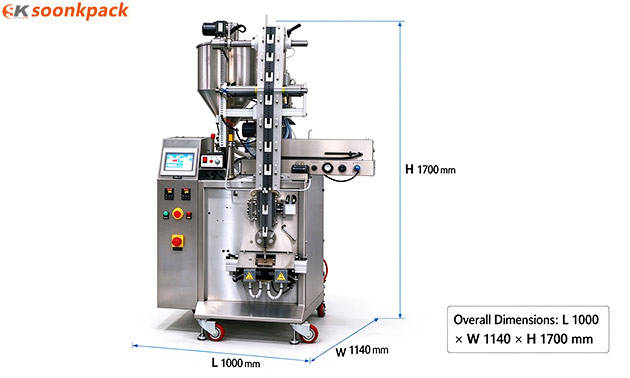
| Machine Dimensions | 1000 mm×1140 mm×1700 mm |
Overcoming Viscosity Challenges in Ketchup Packaging
Tomato ketchup exhibits non-Newtonian fluid behaviors—specifically shear-thinning and thixotropy. Its viscosity fluctuates depending on shear rate, ambient room temperature, and static resting time. When ketchup sits undisturbed in a hopper, its apparent viscosity increases; when agitated or pumped, it flows more readily but tends to produce long, sticky “strings” or “tails” during discharge.
1. Eliminating Seal Contamination & Leakage
The most common cause of sachet leakage in automated sauce lines is seal-zone contamination. If even a tiny drop of ketchup lands on the thermal sealing area of the laminated film, the heat cannot fuse the inner polyethylene (PE) layers together uniformly. This results in capillary micro-leaks, channel voids, and eventual product oxidation or bursting during transit.
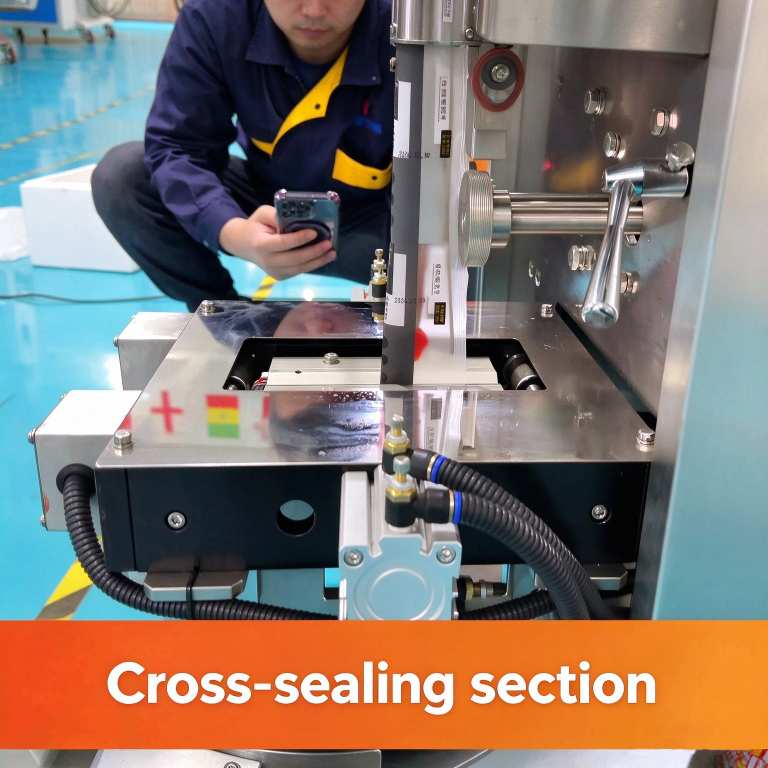
Our machine utilizes a pneumatically driven cut-off anti-drip nozzle. At the precise millisecond the piston pump completes its discharge stroke, a pneumatic internal valve plunger snaps shut directly at the nozzle tip. This mechanical shut-off abruptly breaks the paste stream, swallowing back any lingering tail and guaranteeing that the sealing zone remains completely clean and dry before the heat-sealing jaws close.
2. Ensuring Strict Net-Weight Compliance
Piston-driven volumetric dosing operates on positive displacement. Inside the cylinder, a food-grade PTFE/viton-sealed piston draws a fixed volume of sauce during the intake stroke and discharges the exact volume into the pouch during the delivery stroke.
- Air Bubble Mitigation: The closed-loop cylinder design prevents ambient air entrainment, maintaining a constant density inside the dosing chamber.
- Stroke Fine-Tuning: Operators can adjust fill volume in increments via a micro-handwheel or digitally through the touchscreen interface, ensuring compliance with strict international net-weight regulations ($\le \pm 1\%$ error margin)
In-Depth Engineering & Mechanical Highlights
A. Integrated Hopper with Mechanical Agitator
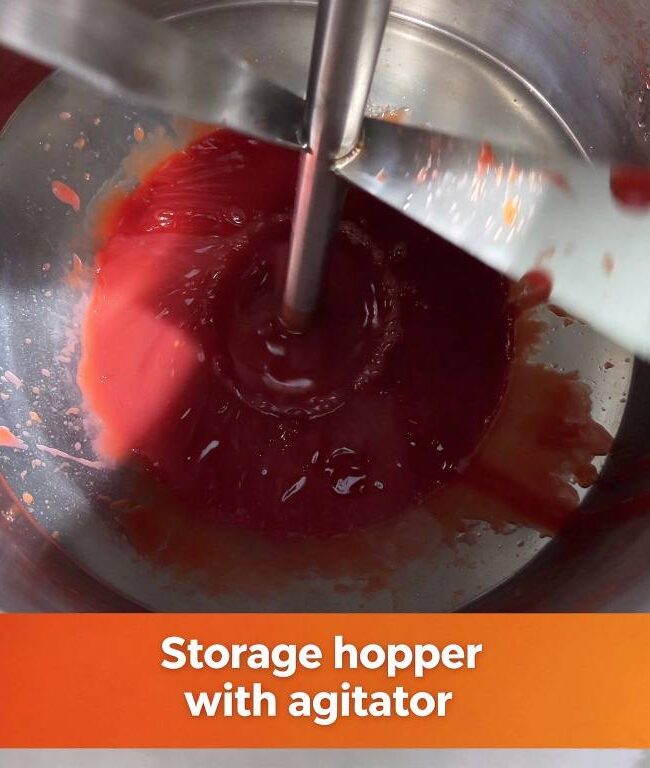
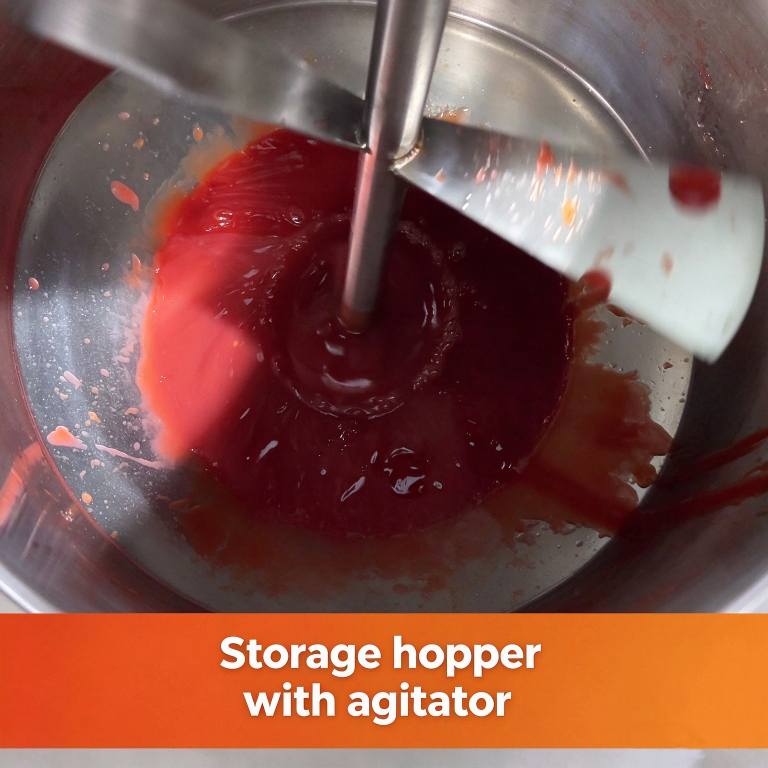
Tomato paste stored in bulk hoppers can experience phase separation or settling over prolonged shifts. To maintain uniform consistency and temperature, the machine is equipped with a 30L–50L stainless steel hopper featuring an integrated motor-driven paddle agitator.
- Optional Upgrades: Double-walled jacketed hoppers with electric heating elements and digital temperature controllers are available for thermal-assisted hot filling of thick syrups, cheese sauces, or viscous pastes.
B. Photoelectric Eye-Mark Tracking
To deliver perfectly centered branding and clear text on every single sachet, the film-unwind system features an advanced photoelectric sensor. The sensor detects printed eye-marks on the back of laminated film rolls, auto-correcting film position in real time to prevent cumulative pitch drift.
C. Independent Temperature Controllers
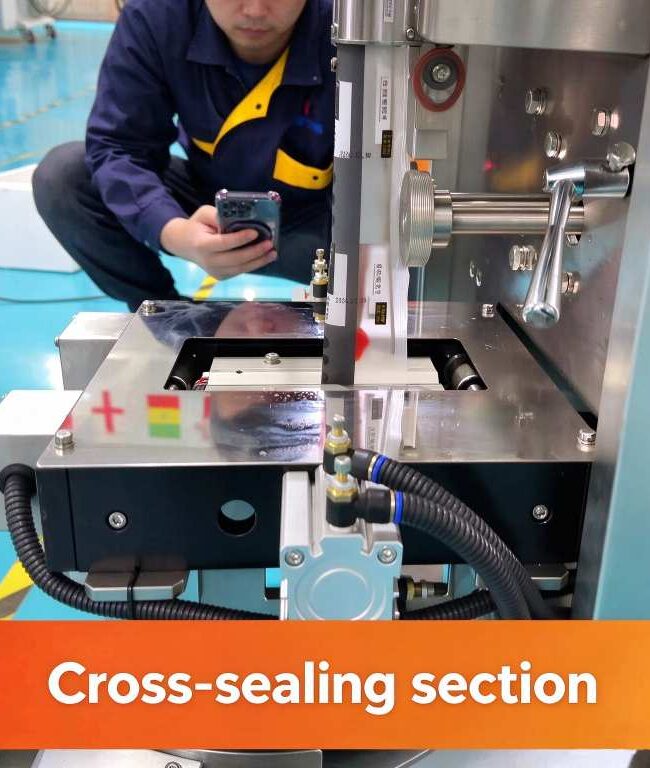
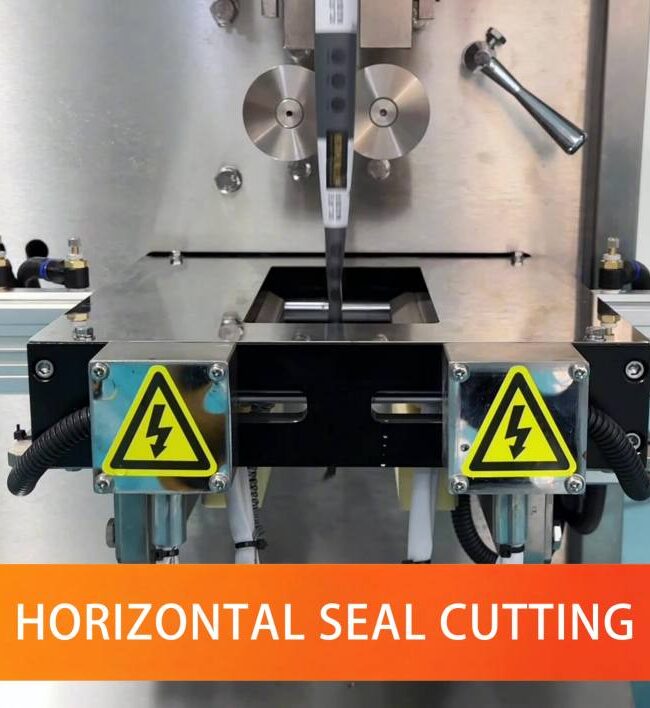
Different composite films—such as PET/PE vs. high-barrier PET/AL/PE—require different sealing temperatures. The machine incorporates dual PID digital temperature controllers for the vertical (side) and horizontal (top/bottom) heat-sealing jaws, maintaining temperature stability within $\pm 1^\circ\text{C}$ to avoid film burning or cold-seal weak spots.
D. Food Safety & Quick Clean-out-of-Place (COP) Design
Hygiene is non-negotiable in commercial food manufacturing. All parts in direct contact with ketchup—including the hopper, three-way rotary valve, piston cylinder, and dispensing nozzle—are fabricated from food-grade SUS304 (or optional SUS316) stainless steel.
- Tool-Free Disassembly: Utilizing quick-release tri-clamp couplings, operators can strip down the entire dosing path without special tools in under 10 minutes for thorough COP cleaning and shift sanitization.
Comprehensive Return on Investment (ROI) & Business Value
Investing in an automated pneumatic sachet packing machine delivers immediate operational savings across labor, material usage, and quality control:
- Dramatic Reduction in Labor Overhead: Manual or semi-automated portion filling is slow, prone to human error, and labor-intensive. A single automated unit operating at 60 bags/minute delivers 3,600 individual sachets per hour, replacing up to 4 manual workers while requiring only one supervisor.
- Material Conservation: Consistent pneumatic volumetric accuracy stops “over-filling” drift—a subtle issue that costs high-volume sauce producers thousands of dollars annually in giveaway raw ingredients.
- Supply Chain Risk Mitigation: Eliminating sachet leaks protects outer carton boxes during long-distance maritime shipping, preventing distributor returns, retailer fines, and damaged customer relationships.
Multi-Paste Material Compatibility
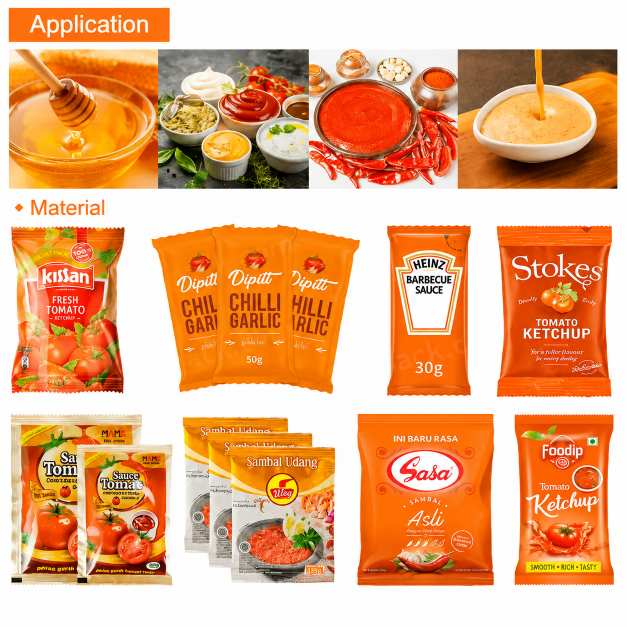
While specifically optimized for tomato ketchup, the machine’s modular pneumatic dosing valve handles a vast array of viscous food and non-food products with simple stroke adjustments:
- Condiments & Dressings: Mayonnaise, salad cream, tartar sauce, thousand island dressing.
- Spicy & Savory Pastes: Chili sauce, Sriracha, garlic paste, ginger paste, curry paste, soybean paste.
- Sweet & Viscous Liquids: Honey, fruit jam, maple syrup, chocolate sauce, condensed milk.
- Non-Food Viscous Products: Cosmetic creams, gels, liquid soaps, shampoo, lubricant pastes.
Troubleshooting & Maintenance Guidelines
To maintain long-term reliability and continuous production uptime, follow these preventative maintenance routines:
- Daily Sanitization: Flush the piston cylinder and valve body with warm water and food-safe sanitizing solution after every shift to prevent sticky sugar/acid buildup on internal O-rings.
- Pneumatic Line Inspection: Check the air filter-regulator unit daily. Ensure inlet air pressure remains stable between $0.6 – 0.8\text{ MPa}$ with a steady air consumption capacity of $0.6\text{ m}^3/\text{min}$.
- O-Ring & Seal Replacement: Inspect piston PTFE seals and nozzle O-rings monthly. Replace worn rubber gaskets proactively to prevent air leakage into the cylinder chamber.
- Sealing Jaw Cleaning: Clean residual film powder or dust off heat-sealing brass/aluminum jaws with a soft brass wire brush while hot to ensure clean seal impressions.
Frequently Asked Questions (FAQ)
Q1: What size sachet can this machine produce?
A: The machine is fully adjustable. Sachet widths range from 30 mm to 150 mm, and sachet lengths range from 50 mm to 200 mm, accommodating film roll widths up to 320 mm. Changing pouch width requires replacing the collar bag former, which takes approximately 15 minutes.
Q2: Can this machine handle ketchup containing solid seeds or chili flakes?
A: Yes. However, if your paste contains larger solid particulates (e.g., chili seeds exceeding 2 mm or pickle bits), we recommend specifying our enlarged rotary valve port and wide-orifice nozzle option to prevent particle clogging.
Q3: What type of packaging film should I use?
A: Any heat-sealable composite film works well. For tomato ketchup (which is acidic and light-sensitive), we strongly recommend high-barrier three-layer laminates like PET/AL/PE or PET/VMPET/PE to extend shelf life and prevent acid corrosion of the film layer.
Q4: How long does it take to change over between different liquid products?
A: Thanks to our quick-release tri-clamp design, the dosing system can be stripped, washed, sanitized, and reassembled in 15 to 20 minutes without using specialized tools.
Partner with Us for Customized Packaging Solutions
Upgrading your condiment packaging line with an automated 3-side seal pneumatic sachet packing machine guarantees strict weight compliance, clean seals, minimal waste, and reduced operating costs.
Contact our application engineering team today to submit your product samples for testing, request detailed technical drawings, or receive a tailored equipment quotation for your production facility.